Heavy PEVVF feeders differ from the base PEVF in drive position — the drive is mounted above the tray rather than below it. This layout is needed where the space below the tray is limited: for example, when the feeder is mounted above a conveyor belt, built into an existing overpass structure, or installed in a tight spot in an operating workshop where a bottom-mounted drive physically will not fit.
The line covers 4 sizes with a capacity of 60 to 150 m³/h at a tray width of 700 to 1200 mm, a lump size of up to 320 mm, and a feeder mass of 1300 to 2600 kg. The drive is the same electromagnetic VEM-T1-T4 used on the bottom-drive design, so the drive's own specifications, capacity control, and control-unit requirements are unchanged.
Like the PEVF, this feeder is sized to receive material directly from a hopper or below a screen and runs steadily under the static load of coarse lump material. The choice between PEVF and PEVVF comes down purely to the available mounting clearance, not the properties of the material being conveyed.
If the space below the tray is not limited, the standard bottom-drive PEVF is the more common and often more economical choice at the same capacity.
PEVVF units are used at the same kind of plants as the PEVF, chiefly mining and processing facilities where the specific site does not allow a bottom-mounted drive — see the mining industry page for an example task. The vibration isolators and supporting structure for a top-mounted drive are sized separately from the bottom-drive design, since the shifted centre of gravity changes how the load is distributed on the frame.
What is the difference between ПЭВФ and ПЭВВФ, and when is a top-mounted drive needed?
Only by drive position: ПЭВФ mounts the drive below the tray (the base layout), while ПЭВВФ mounts it on top, for cases where space below the tray is limited — for example, above a conveyor.
Both designs use the same VEM-T1-T4 drive lineup with identical specifications — only their position relative to the tray differs, along with the resulting calculation for the support structure and vibration isolators to account for the shifted center of gravity. A top-mounted drive (ПЭВВФ) is chosen not for the material's properties but for a space constraint at the installation site: the feeder is built into an existing overpass, mounted above a conveyor gallery, or fitted into a tight shop-floor layout where a bottom-mounted drive physically will not fit. If space below the tray is available, the standard ПЭВФ design is usually more economical and more common at the same capacity.
| Model | Tray, mm | Capacity, m³/h | Mass, kg | Drive |
|---|---|---|---|---|
| ПЭВВФ 700/315х1600-60 | 700×1600 | 60 | 1300 | ВЭМ-Т1 |
| ПЭВВФ 950/370х2000-90 | 950×2000 | 90 | 1600 | ВЭМ-Т2 |
| ПЭВВФ 1200/280х2000-150 | 1200×2000 | 150 | 1700 | ВЭМ-Т3 |
| ПЭВВФ 1200/280х2500-150 | 1200×2500 | 150 | 2600 | ВЭМ-Т4 |
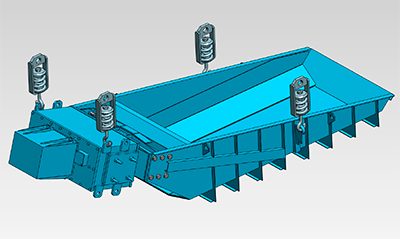
ПЭВВФ 700/315х1600-60
ПЭВВФ 950/370х2000-90
ПЭВВФ 1200/280х2000-150