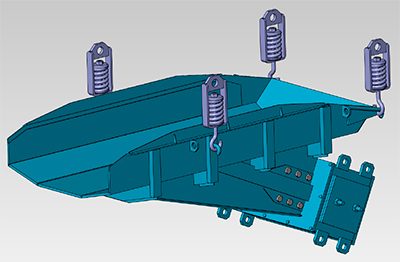
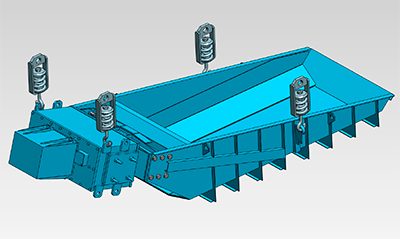
Heavy PEVF/PEVVF electromagnetic feeders for receiving ore, agglomerate and pellets from hoppers and below screens in crushing-and-screening plants.
At mining and processing plants, a vibrating feeder usually runs under the heaviest duty cycle: receiving coarse-lump material straight from a hopper, impact loads when the hopper is full, and abrasive wear on the tray from ore or agglomerate. The catalog covers this with the PEVF series (bottom-mounted drive) and PEVVF series (top-mounted, for limited space below the tray — e.g. mounting above a conveyor belt).
A feeder with no rotating parts can run "under a full hopper" — effectively acting as a hopper gate, switching on and off from a level sensor in the receiving bin. That cuts wear compared with continuously running equipment and simplifies automation: the feeder integrates into a process control system without extra converters.
The key parameters for mining are maximum lump size (listed in each model's datasheet) and tray wear resistance: for abrasive materials, a lining or a thicker tray plate can be specified individually when the order is placed. This line is rated for material temperatures up to +200°C, covering most agglomerate and pellet applications.
For ore, agglomerate and other abrasive material, the tray is fitted with a wear-resistant lining — rubber, polyurethane or steel plate depending on abrasiveness and material temperature; the exact composition and thickness are specified for the task when placing a request, since it is not part of the base configuration.
For ore, agglomerate and other abrasive material, the tray is fitted with a wear-resistant lining — rubber, polyurethane, or a thicker steel plate, depending on the material's abrasiveness and temperature. Rubber absorbs impact well and suits most moderate-abrasion tasks; polyurethane resists abrasion better than rubber at comparable elasticity; steel lining is used for the harshest abrasive wear, where elastic materials wear through quickly. The exact lining composition, thickness and mounting method are not part of the base feeder configuration and are specified individually for the material and duty cycle when placing a request.
Russia’s largest producer of magnesia refractories, running the full cycle from mining to processing. Deliveries were made every year over the entire tracked period.
For ore, agglomerate and other abrasive material, the tray is fitted with a wear-resistant lining — rubber, polyurethane or steel plate depending on abrasiveness and material temperature; the exact composition and thickness are specified for the task when placing a request, since it is not part of the base configuration.
No, mining plants use the same catalog ПЭВФ and ПЭВВФ feeders as everyone else — the size is chosen by required capacity, tray width matching the hopper opening, and maximum lump size, the same way as for any other industry.
Yes, a preliminary sizing only needs the required capacity, lump size and bulk density. Exact dimensions and mounting points are confirmed at the support-structure design stage, once a hopper drawing exists.
Yes, ШУВ/БУВ control devices support integration with external automation loops — the protocol and connection method are confirmed for the specific plant's system when placing a request.