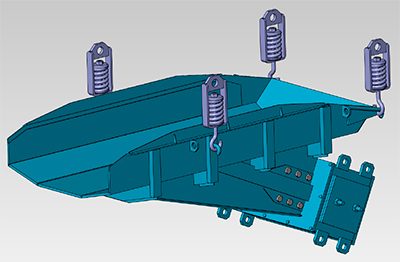
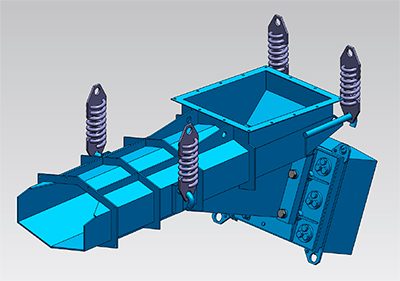
Electromagnetic feeders for feeding agglomerate, pellets, flux and ferroalloys at ferrous and non-ferrous metallurgy plants.
At metallurgical and ferroalloy plants, vibrating feeders are used in burden preparation and metering areas: feeding agglomerate and pellets to a blast furnace shop, metering flux and ferroalloys, and moving material between process stages. Some materials (limestone, coke breeze, powdered ferroalloys) need dust containment — for that, a covered-tray design is used (the "U" suffix, PEVU series).
The electromagnetic drive is adjusted smoothly from zero to maximum by changing the coil voltage, which gives the metering accuracy that burden preparation to a recipe needs. Unlike drives with a mechanical unbalance mass, there's no stepped adjustment and the error that comes with it.
Feeders are rated for material temperatures up to +200°C — usually enough for agglomerate and pellets after conveyor cooling, but for higher-temperature material straight out of a furnace a solution is sized individually: send us your process parameters via the request form.
One of the largest full-cycle steel plants in the Urals. Heavy-duty feeders were supplied for dosing points across the steelmaking process.
No, these are different tasks: agglomerate and pellets are coarse abrasive material for the ПЭВФ/ПЭВВФ line, while powdered ferroalloys and lime need dust containment, which calls for the covered-tray ПЭВУ design.
The electromagnetic drive is adjusted smoothly from zero to maximum by changing coil voltage through the control unit — unlike drives with a stepped mechanical unbalance mass, this holds a set recipe ratio more precisely during burden preparation.
The standard design is rated up to +200°C — for higher-temperature material straight from a furnace, a solution for drive and seal materials is sized individually; send us your process parameters via the request form.